
Key takeaways
- SAP Cloud ALM supports application lifecycle management across implementation, monitoring, operations, and continuous optimization.
- Organizations can improve delivery discipline, operational visibility, issue management, and collaboration by connecting project execution with ongoing operations.
- E-Strategy helps clients use SAP Cloud ALM as part of a broader governance and continuous improvement model.
Key takeaways
- SAP Cloud ALM supports application lifecycle management across implementation, monitoring, operations, and continuous optimization.
- Organizations can improve delivery discipline, operational visibility, issue management, and collaboration by connecting project execution with ongoing operations.
- E-Strategy helps clients use SAP Cloud ALM as part of a broader governance and continuous improvement model.
Why this matters now
SAP transformation programs require more than project plans. They need structured delivery, stakeholder alignment, task visibility, testing readiness, system monitoring, integration visibility, and operational follow-through after go-live. SAP Cloud ALM provides cloud-based lifecycle management capabilities that support implementation and operations across SAP landscapes.
For organizations adopting SAP Cloud ERP, SAP Cloud ERP Private, SAP BTP, SAP Integration Suite, SAP SuccessFactors, SAP Ariba, or other SAP solutions, SAP Cloud ALM can help create a clearer view of what is being delivered, how systems are performing, and where attention is needed.
E-Strategy perspective
At E-Strategy, we see SAP Cloud ALM as a practical enabler for delivery confidence and operational discipline. It helps teams connect implementation execution with post-go-live operations, reducing the gap between project work and long-term value realization.
We help clients define how SAP Cloud ALM fits into governance, release planning, monitoring, AMS, and continuous improvement. The goal is not to add another tool. The goal is to create better visibility, faster response, and stronger accountability across the SAP lifecycle.
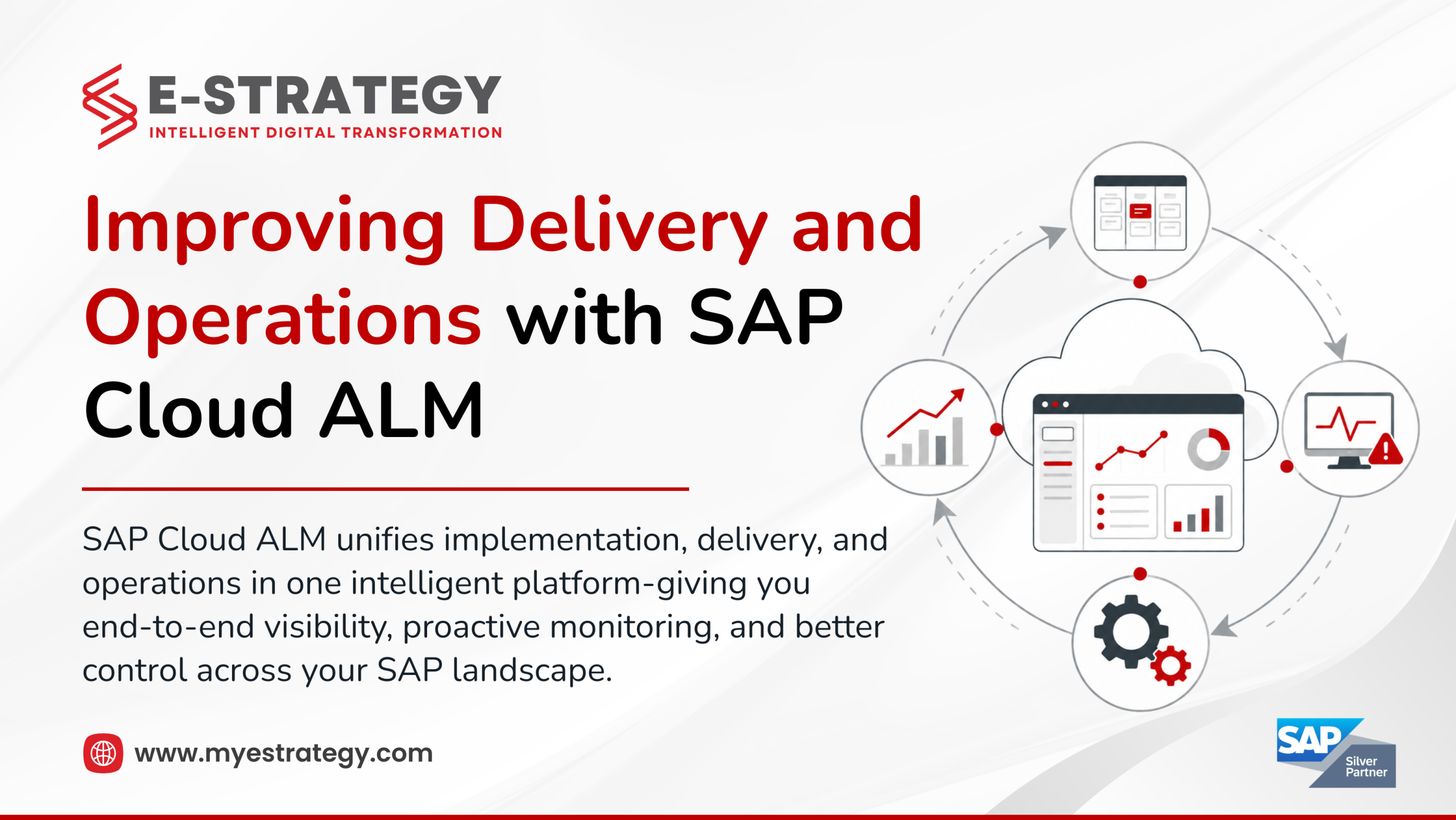
Four focus areas for SAP Cloud ALM
- Implementation management: Track tasks, milestones, scope, responsibilities, and project progress with greater transparency.
- Monitoring and observability: Gain visibility into system health, processes, integration flows, and performance indicators.
- Operations and issue management: Improve detection, triage, root-cause analysis, and resolution of operational issues.
- Continuous improvement: Use insights from delivery and operations to guide enhancements, release planning, and optimization.
Where E-Strategy helps
- SAP Cloud ALM setup and lifecycle management planning
- Implementation governance and project delivery support
- Monitoring and operations model design
- Integration monitoring and incident process alignment
- AMS connection with SAP Cloud ALM insights
- Continuous improvement roadmap and KPI definition
Business outcomes to target
- Improved delivery visibility and project control
- Faster issue identification and resolution
- Reduced operational risk after go-live
- Better collaboration across IT, business, and implementation teams
- More reliable release and change management
- Continuous optimization of SAP landscapes
Next Step
Explore how E-Strategy can help improve SAP delivery visibility, operations, and continuous monitoring with SAP Cloud ALM.
SAP Cloud ALM helps organizations connect delivery and operations in one lifecycle view. E-Strategy helps clients use that visibility to improve governance, reduce risk, and drive continuous value across SAP landscapes.