
Key takeaways
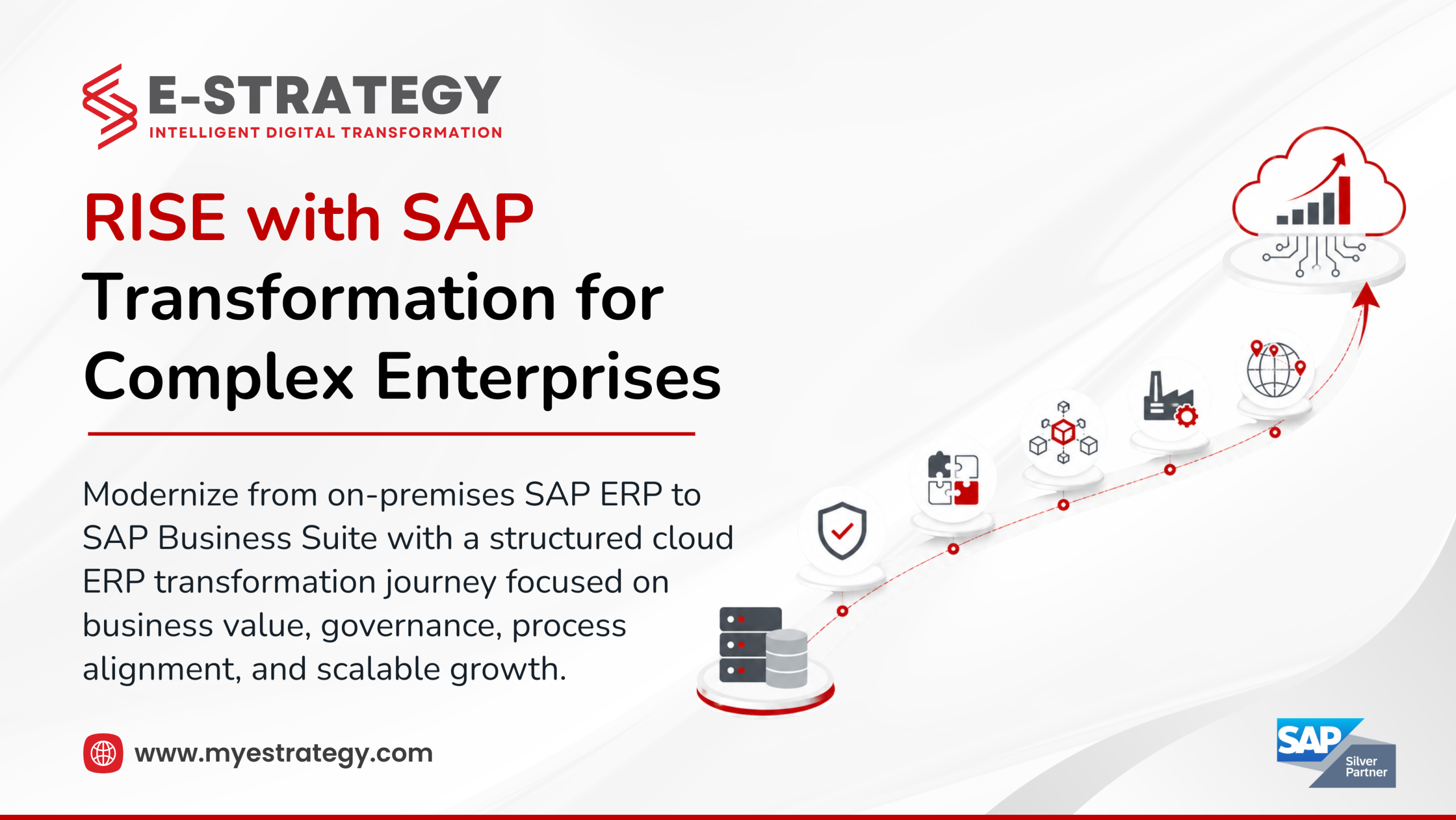
- RISE with SAP supports enterprise modernization by helping organizations move from on-premises SAP ERP landscapes to SAP Business Suite through a structured cloud ERP transformation journey. SAP positions RISE with SAP as a journey for on-premises SAP ERP customers to modernize their business with Business Suite, supported by proven methodology, a cloud operating model, and investment protection.
- Complex enterprises need more than a technical migration plan. They need a transformation roadmap that connects business value, governance, process alignment, integration, data readiness, and long-term adoption.
- E-Strategy helps enterprises translate the RISE with SAP journey into practical execution, including transformation planning, clean core readiness, SAP BTP extensions, manufacturing process modernization, supply chain visibility, and intelligent decision-making with SAP Business AI.
Introduction
For complex enterprises, ERP modernization is no longer only about moving systems to the cloud. It is about building a connected, scalable, and intelligent enterprise foundation that can support business change, operational visibility, and continuous innovation.
The RISE with SAP journey gives organizations a structured path to modernize existing SAP ERP landscapes and move toward SAP Business Suite, supported by cloud ERP, SAP Business AI, clean core principles, and integrated transformation capabilities. SAP describes the RISE with SAP Methodology as a way to help organizations transform and modernize ERP landscapes, realize the full potential of SAP Business Suite, and drive continuous innovation.
For enterprises operating across manufacturing, supply chain, finance, procurement, distribution, and global operations, the opportunity is significant. But so is the need for disciplined execution.
That is where E-Strategy helps.
At E-Strategy, we work with organizations to turn SAP transformation ambition into a practical roadmap that aligns business outcomes, processes, technology, data, governance, and operating models.
Why RISE with SAP Matters for Complex Enterprises
Large and mid-market enterprises often operate with layered ERP environments, multiple integrations, custom processes, legacy reporting structures, and industry-specific operational requirements. These landscapes support critical business operations, but they can also create complexity when organizations need to scale, standardise, or innovate faster.
RISE with SAP provides a transformation path for organizations looking to modernize their ERP foundation while protecting business continuity and enabling future innovation.
For complex enterprises, the value of RISE with SAP is not only in cloud adoption. It is in creating a foundation for:
- Modern SAP Cloud ERP operations
- Process standardization and harmonization
- Clean core execution
- Improved data quality and visibility
- Faster adoption of SAP innovation
- Better integration across SAP and non-SAP systems
- Intelligent decision-making with SAP Business AI
- Scalable transformation across business units and geographies
E-Strategy helps organizations approach this journey with a clear focus: move from ERP modernization to measurable business value.
The E-Strategy Perspective: Transformation Must Start with Business Value
Technology transformation succeeds when it is connected to business outcomes from the beginning.
For complex enterprises, the first question should not be, “How quickly can we migrate?” It should be:
What business value should this transformation unlock?
That value may include:
- Faster financial close
- Better manufacturing visibility
- Improved supply chain planning
- Reduced process variation
- Lower operational complexity
- Improved governance and compliance
- Better user experience
- Greater agility for future growth
- Stronger data foundation for AI and analytics
E-Strategy helps organizations define transformation priorities before execution begins. This ensures the RISE with SAP journey is aligned with business strategy, not treated as a standalone technology program.
Building a Practical RISE with SAP Transformation Roadmap
A successful RISE with SAP transformation requires structure, governance, and sequencing. For complex enterprises, the roadmap should connect strategy, process, technology, people, and data.
1. Define the Business Case and Transformation Outcomes
The transformation roadmap should begin with measurable goals.
Common priorities include:
- Improving operational efficiency
- Reducing ERP complexity
- Increasing process standardization
- Enabling scalable cloud adoption
- Improving reporting and decision-making
- Supporting manufacturing and supply chain modernization
- Preparing for AI-enabled operations
E-Strategy helps organizations define the “why” behind transformation so the program remains focused on value realization.
2. Assess Current ERP Landscape and Process Readiness
Complex enterprises often have customized processes, legacy integrations, and business-specific workflows that have evolved over time.
Common priorities include:
- Which processes should be standardized
- Which customizations still create business value
- Which integrations are critical
- Which data issues could affect transformation
- Which business units are ready for change
- Which operating risks need to be managed
This assessment helps create a realistic roadmap instead of a generic migration plan.
3. Align with Clean Core Principles
Clean core is a critical concept in modern SAP transformation. SAP describes clean core as guiding principles that help organizations keep business-critical systems agile, cost-effective, and ready to adopt innovation. SAP also connects clean core execution with RISE with SAP Methodology, standardization, and modern extensibility.
For complex enterprises, clean core does not mean removing every unique business requirement. It means making smart decisions about what belongs in the core and what should be handled through extensions, integrations, automation, or side-by-side innovation.
E-Strategy helps organizations:
- Review existing customizations
- Identify what should remain standard
- Move appropriate extensions to SAP BTP
- Reduce upgrade friction
- Improve governance around future changes
- Support innovation without adding unnecessary technical debt
4. Use SAP BTP to Extend, Integrate, and Innovate
SAP Business Technology Platform plays a key role in modern SAP transformation. It enables organizations to extend, integrate, automate, and build applications while supporting clean core principles.
For complex enterprises, SAP BTP can support:
- Side-by-side extensions
- Integration with SAP and non-SAP systems
- Custom workflows and applications
- Automation scenarios
- Data and analytics use cases
- AI-enabled business processes
- Manufacturing and supply chain integration
E-Strategy helps organizations identify where SAP BTP can support business-specific needs without disrupting the ERP core.
5. Improve Manufacturing and Supply Chain Visibility
For manufacturing-driven enterprises, RISE with SAP transformation should improve more than back-office processes. It should strengthen visibility across operations, production, inventory, procurement, logistics, and supply chain planning.
Common focus areas include:
- Real-time production visibility
- Better inventory and demand planning
- Supplier and procurement integration
- Improved operational reporting
- Manufacturing process standardization
- Connected shop-floor and enterprise data
- Faster response to supply chain disruptions
E-Strategy supports manufacturing organizations by aligning ERP modernization with operational improvement, supply chain transparency, and data-driven decision-making.
6. Enable Intelligent Decision-Making with Integrated SAP Platforms
SAP Business Suite brings together applications, data, and AI capabilities to help organizations run connected business processes. SAP describes SAP Business Suite as integrating AI and real-time data into SAP’s business applications, with SAP Business AI embedded across the suite and Joule supporting connected workflows.
For enterprises, this creates the opportunity to move from reporting after the fact to more intelligent, proactive decision-making.
Examples include:
- Predictive supply chain insights
- Finance and operations analytics
- AI-supported exception handling
- Automated workflow recommendations
- Business performance dashboards
- Process intelligence through SAP Signavio
- Operational monitoring through SAP Cloud ALM
E-Strategy helps organizations identify which intelligent capabilities should be prioritized first based on business value, data readiness, and process maturity.
Governance: The Difference Between Migration and Transformation
For complex enterprises, governance is one of the most important success factors.
A strong governance model should define:
- Business ownership
- Program decision rights
- Process standardization rules
- Clean core controls
- Data quality ownership
- Integration governance
- Change management approach
- Value realization metrics
Without governance, transformation can become fragmented across business units and technical teams. With governance, organizations can make faster decisions, reduce rework, and protect the long-term value of the SAP landscape.
E-Strategy helps organizations establish governance structures that connect executive priorities with delivery execution.
Where E-Strategy Helps
E-Strategy supports organizations across the RISE with SAP transformation lifecycle, from strategy and readiness to execution and continuous improvement.
Our focus areas include:
- RISE with SAP transformation roadmap planning
- SAP Cloud ERP Private readiness and adoption support
- Business case and value alignment
- Clean core assessment and governance
- SAP BTP extension and integration strategy
- Manufacturing process modernization
- Supply chain visibility and optimization
- SAP Business AI use-case identification
- SAP Signavio process transformation support
- SAP Cloud ALM delivery and operations visibility
- SAP AMS and continuous improvement after go-live
Our goal is to help enterprises move beyond technical modernization and achieve measurable business outcomes across SAP transformation programs.
Business Outcomes Enterprises Should Target
A well-planned RISE with SAP transformation should create outcomes that can be measured and communicated to business leaders.
Key outcomes may include:
- Reduced ERP complexity
- Faster access to innovation
- Improved process consistency
- Better manufacturing and supply chain visibility
- Stronger governance and compliance
- Improved data quality
- Faster decision-making
- Reduced customization risk
- Improved operational efficiency
- Better readiness for SAP Business AI and analytics
The most successful programs define these outcomes early and track them throughout the transformation journey.
Common Readiness Questions for Executives
Before beginning or accelerating a RISE with SAP transformation, enterprise leaders should ask:
- Which business outcomes are most important to achieve?
- Which processes should be standardized?
- Which customizations are still business-critical?
- Which integrations need to be redesigned or modernized?
- Is our data ready to support better analytics and AI?
- How will we maintain clean core principles over time?
- How will SAP BTP support extensions and innovation?
- What governance model will guide decisions?
- How will we measure value after go-live?
- What operating model will support continuous improvement?
These questions help organizations move from planning to practical execution.
Conclusion: Turning the RISE with SAP Journey into Business Value
RISE with SAP gives complex enterprises a powerful path to modernize ERP environments, adopt a cloud operating model, and move toward SAP Business Suite. But the real value comes from how the transformation is planned, governed, executed, and continuously improved.
For organizations with complex operations, manufacturing requirements, supply chain dependencies, and integrated SAP landscapes, success requires a practical roadmap that connects technology with business outcomes.
E-Strategy helps enterprises build and execute that roadmap with a focus on business value, clean core, SAP BTP innovation, process alignment, intelligent decision-making, and long-term operational excellence.
Planning a RISE with SAP transformation for a complex enterprise environment?
Connect with E-Strategy to discuss how your organization can build a practical transformation roadmap across ERP modernization, clean core, SAP BTP, manufacturing operations, supply chain visibility, and intelligent decision-making.
Talk to E-Strategy About Your RISE with SAP Transformation Roadmap